Fatty Acid Composition Analysis
Discover your food's fatty-acid composition, with a clear breakdown of the fats in your sample and access to the data and analysis behind your result.
$125 / sample
Turnaround: 1–2 weeks from lab receipt
- Quantitative GC-FID fatty-acid profiling (37-component FAME reference mix)
- Individual fatty acids reported as weight percent of total fatty acids
- Saturated, monounsaturated, polyunsaturated, and omega-3/6 summaries
- Full sample event graph, instrument data trace, and analysis script available
- Published method and guidance to help you understand your profile
Pesticide/residue screening for each food type is in development — join the newsletter on the homepage to hear when it opens.
Why this test matters
Measure the fatty-acid composition of the yolk, including the relative proportions of omega-3 and omega-6 fatty acids.
See the proportions of individual fatty acids in the finished food. The profile provides a starting point for comparison with its listed ingredients.
See EPA and DHA as percentages of total fatty acids in your sample. Composition percentages describe the balance of fats; measuring milligrams per capsule requires a separate measurement of quantity.
See the trans fatty acids resolved by the method, with detection limits to help you interpret small amounts.
Compare individual fatty acids and summary groups across samples. The profile can inform questions about feeding practices, though it cannot certify a grass-fed claim on its own.
What you can send
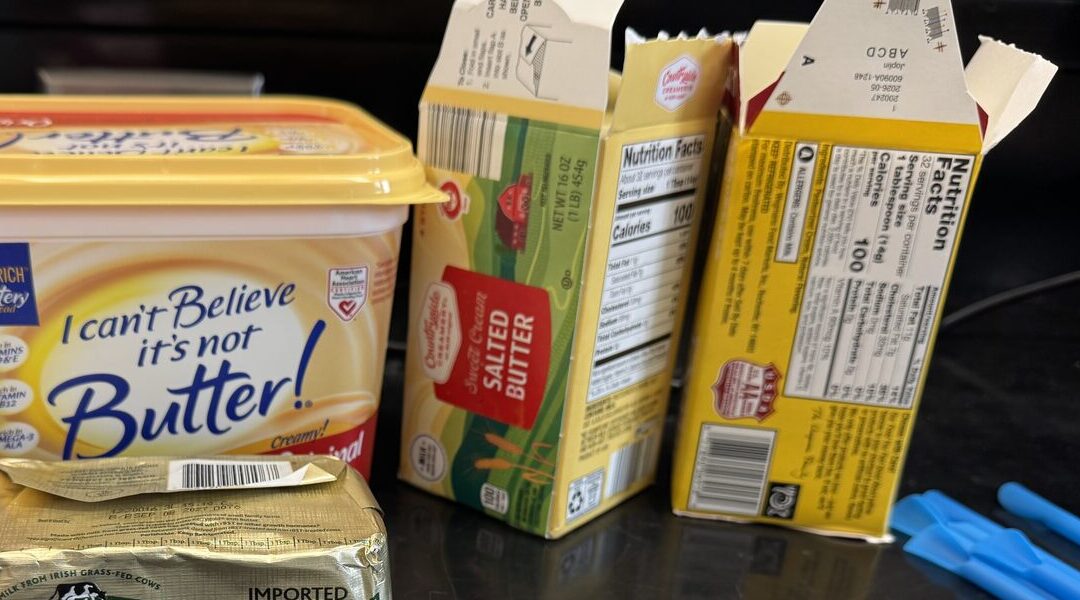
Butter or other fat/oil
Butter, ghee, tallow, lard, coconut oil, margarine, or any spread.
Max sample weight: 10 g
Eggs
3–6 eggs in the shell. We profile yolk fatty-acid composition.
Meat
Cooked or raw meat — keep chilled, roughly 50 g.
Max sample weight: 50 g
Dairy
Cheese, milk, or yogurt. Liquids in the supplied tube.
Max sample weight: 50 g
Vegetables & fruit
Low-fat matrices are supported; we extract available lipid first.
Max sample weight: 100 g
Grains & nuts
Flour, rice, oats, nuts, or seeds.
Max sample weight: 50 g
Processed food
Potato chips, crackers, bars, and frozen foods. Explore the fats in the foods you eat every day.
Max sample weight: 50 g
Method
Lipids are extracted from the homogenized sample, converted to fatty acid methyl esters (FAME), and separated by gas chromatography with flame ionization detection (GC-FID) against a 37-component FAME reference mix. Results report weight percent of total fatty acids for each resolved component, plus derived indices (SFA/MUFA/PUFA, omega-6:omega-3, trans total). Read the published overview on our Methods page; your sample's supporting record lets you explore the data and calculations behind your report.
Frequently asked questions
How much sample do I send?
Less than you think — the kit specifies the exact amount for your sample type, typically 10–50 g. The return packaging is supplied in the kit.
Why isn't the price different per sample type?
The instrument run is the same regardless of matrix. Extraction adds labor for low-fat foods; complex matrices may incur a stated surcharge noted at checkout.
What comes with my result?
A quantitative report and interpretation, with access to your full sample event graph, instrument data trace, and the analysis script that calculates the percentages. Contact us with your order ID to explore the supporting record.
What can I use the report for?
Explore your food's composition, compare samples, and ask informed questions about ingredients. Reports are for personal information. Accreditation details and our quality practices are on the Quality page.
Also coming soon: Pesticide & Residue Screening → · See all tests →